
Best Practices
Best Practices for Everyone
There are many things you can do to reduce and recycle waste at your work place. A robust recycling program benefits the local economy, protects our environment, conserves energy & natural resources and can help demonstrate your organization’s commitment to sustainability and the community. Furthermore, the Minnesota commercial recycling law requires most businesses who collect four or more cubic yards of waste per week to recycle at least three types of materials.
BizRecycling Resources
After helping thousands of businesses, we’ve identified the best practices below as the most simple and effective actions for any business to reduce waste and recycle better.
Standardize Trash, Recycling, and Organics (Food Waste) Bins
Our research shows that clear bin placement is the single, most effective action you can take.
- Color-Code Bins
- Black or grey for trash
- Blue for recycling
- Green for food waste
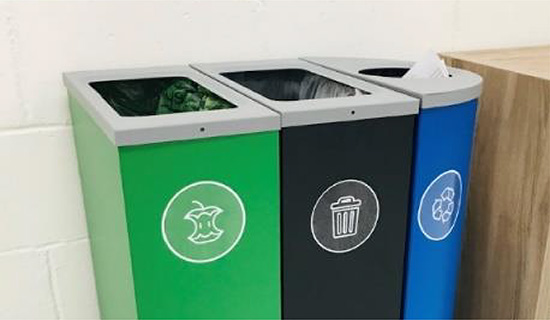
- Clearly Label Bins
- Label each bin using the color system above. Include simple images of items that go in the bin. Use labels in languages your residents/customers/staff are familiar with. (Order labels for free here.)
- Co-Locate Bins
- Always place trash, recycling and food waste bins together.
Educate Staff, Customers and Residents
Recycling is simple and hard at the same time, mostly because what is or is not recyclable is hyper local to the area where you live or work. However, when people learn how to properly recycle, they are more likely to participate.
- Host a virtual or in-person training session with one of BizRecycling’s Recycling Experts. (We even have funds to pay for staff time, food, and incentives!)
- Include recycling information in your resident or staff newsletters and meetings.
- Hang educational posters in your common areas.
- Share feedback on how everyone is doing, especially your wins! People are motivated by knowing their actions make a difference.
Conduct Waste Audits
A waste audit is a sophisticated dumpster dive to analyze what is being thrown away and if it has been separated into the proper waste stream. Waste audits are especially important for entities that generate a lot of waste. It can help you:
- Identify problem materials to target waste reduction and recycling education efforts.
- Assess the effectiveness of your recycling efforts with data.
- Use data to provide a feedback loop to your staff or tenants.
- Use data to help you “right-size” trash, recycling and food waste bins and hauling services.
Update Your Hauler Contract
Did you sign it and forget about it? Does it auto renew without your knowledge? Many hauler contracts last multiple years and auto renew with a very limited window of opportunity to cancel them. If you want to save money after implementing your new waste reduction, recycling and food waste efforts, you will need to make changes to your hauler contract. These are things to consider.
- Make sure that the size of your dumpsters and frequency of pick-up matches the amount of waste you produce. After implementing new recycling and food waste collection efforts, you may be able to decrease the size of your trash dumpster or frequency of pick-up.
- Make sure you understand all the fees on your invoice. If not, talk to your hauler about them and look at this resource for help. Contracts are often negotiable.
- Routinely get bids from multiple haulers.
Stick to One Type of Material for Food Service Products
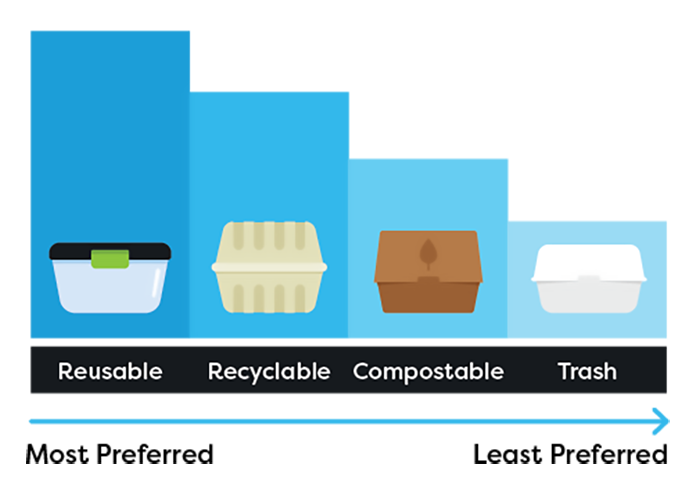
When serving food, choose one material type for food service products – reusable, recyclable or BPI certified compostable products – and only offer that material type. Confusion between trash, recyclable and compostable food service products is the main source of contamination in dining areas. Make it easier for folks by only having one option.
Takeout Container Options
Identify Opportunities for Reusable Materials
Look at the materials you throw away again and again. Is there a reusable option? What changes to purchasing, operations or equipment would make it feasible for your business to change to a reusable version? Some common opportunities include:
- Switching from disposable plastic forks, spoons, and plates to reusables in employee break areas, cafeterias, and restaurants.
- Installing water bottle fillers instead of providing bottled water.
- Replacing (or eliminating) delivery of disposable shipping materials with reusable options like crates or totes.
Identify Opportunities for Waste Reduction
While recycling, collecting food scraps and reuse are important parts of proper waste management, reducing waste is the best step you can take to protect the environment and your pocketbook! Waste reduction means that you prevent it from being created in the first place. Some examples of waste reduction at businesses include:
- Buying in bulk to reduce packaging waste
- Changing packaging to reduce waste
- Redesigning the production process to maximize materials
Best Practices by Waste Stream
Single-Sort or “Mixed” Recycling
This refers to a collection method in which many types of recyclable items are collected in one container for transportation to a recycling processing center. The following are some helpful tips for single sort recycling.
- Contact your hauler to confirm accepted items. Accepted items may differ among haulers. Not all materials displaying the recycling symbol can be placed in single-sort recycling.
- Keep recyclables as clean and dry as possible. Paper should be dry, and all food and beverage containers should be free of food and liquids. Work with your hauler and the recycling processing center if you are managing recyclables in a compactor.
- Never send your recyclables to the recycling processing center in plastic bags because the bags get tangled in the sorting equipment. If you collect your recyclables in plastic bags, shake them out so they are loose in your cart, dumpster or compactor.
- Pair color-coded and labeled trash, recycling and food waste bins across your facility.
For more information, visit Ramsey Recycles and the Washington County Disposal Directory.
Food Waste
Whether there is a surplus of edible food or large quantities of food scraps in your trash, food waste is a concern for many businesses, schools and organizations. Recycling food scraps can save money by diverting heavy, wet material from your trash collection. The following are a few actions you can take to play your part in preventing food waste.
- Food donation: You can donate certain edible foods to food rescue organizations.
- Organics/food scraps collection: Turn your food scraps into compost. Compost is a nutrient-rich amendment used to improve soil. Organics/food scraps collection programs for businesses require a hauler to pick up your organics and deliver it to a commercial facility where it can be turned into compost.
- Food to animal feed: Turn your expired food, food scraps, and food not suitable for donation into animal feed. Food to animal feed programs for businesses require a farm to pick up your food scraps and process it into animal feed.
Hazardous Waste/Problem Materials
Hazardous waste is any waste that poses a risk to human health or the environment. All hazardous waste generators, regardless of size, are required to follow laws and regulations around proper waste disposal. The following are steps you should take to determine if your business produces hazardous waste.
- Gather information about the waste your business produces.
- Evaluate the waste using the Evaluate Waste guide from the MPCA.
- Get a license or register as a generator. You can find more information on your county’s website.
- Dispose of your waste properly. If you are considered a Very Small Quantity Generator (VSQG), you can dispose of your waste through your county’s VSQG program. Otherwise, consult your county website for a list of safe disposal sites in your area.
For more information, visit Ramsey County or Washington County’s hazardous waste webpages.
Best Practices by Industry
Learn best practices in waste, recycling and organics management for your industry. For customized recommendations for your business and grant funding to implement best practices, schedule a visit with a Recycling Expert.
Helpful Sites
Recycling Experts
County Recycling Websites
State & Local Recycling Resources
Food Donation and Recycling Resources
- Feeding America: Food bank locator
- Waste Not, Want Not: Feeding the Hungry and Reducing Solid Waste Through Food Recovery (pdf)
- Barthold Recycling: Food scraps to hogs
- ReConserve (formerly Endres): Recycles bakery and food byproducts into animal feed
- Sanimax: Hauler for cooking oil, organics, animal and meat by-products, hides and skins
Organics Recycling Resources
- Aspen Waste Systems: Organics hauler
- Dakota Prairie Composting: Composting facility
- SKB Environmental: Organic waste drop off facilities
- Specialist Environmental Technologies (SET): Composting facility
Donating
- Habitat for Humanity ReStore: Construction materials, new and working used appliances, furniture, household goods
- Minnesota Materials Exchange: Free service that links businesses and organizations that have reusable goods they no longer need to places that can use them